
Thaddeus Stevens: A Conservative Critique of a Radical Reformer.
Thaddeus Stevens was once one of the most influential men in American politics. A committed abolitionist who fought to end slavery, a leading advocate for the civil rights of Black Americans and the principal architect of Congressional Reconstruction. He helped shape the United States that emerged from the Civil War. Once a household name, Stevens has since faded from public consciousness, despite leaving an indelible mark on the nation’s political and constitutional development.
His legacy remains as contested today as it was during his lifetime. To his admirers, Stevens was a principled statesman who sought to secure liberty and equality under the Constitution. To many conservatives, both in his own era and today, he represents the dangers of centralised government, punitive policy making, and ideological overreach during Reconstruction.
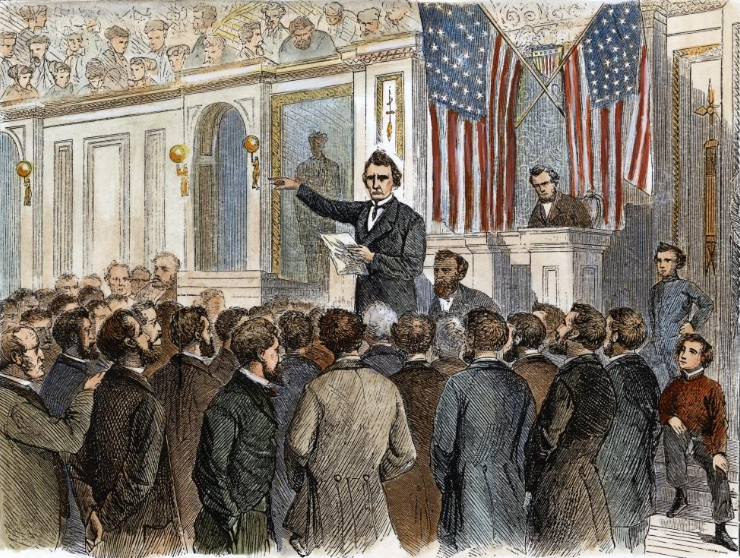
From a conservative standpoint, Stevens’ greatest flaw was his belief that the federal government should wield sweeping authority over the former Confederate states. After the Civil War, he argued that the South had forfeited many of its constitutional rights through rebellion and should remain under strict congressional supervision before being readmitted to the Union. Opponents regarded this as a fundamental departure from the constitutional balance between the states and the federal government.
Stevens also championed extensive protections for formerly enslaved Americans, including civil rights legislation and, at times, proposals to confiscate land from wealthy Confederate planters for redistribution. Supporters viewed these measures as essential to securing the promise of emancipation. Conservatives, however, argued that they undermined property rights, weakened constitutional safeguards, and further expanded federal authority into areas traditionally reserved to the states.
Reconstruction itself remains another major point of contention. Many conservative historians argue that Reconstruction governments depended heavily upon military occupation and federal enforcement. In their view, these policies deepened sectional resentment, delayed national reconciliation, and established lasting precedents for an increasingly powerful central government at the expense of state sovereignty.
Stevens’ uncompromising political style has attracted similar criticism. As one of the leading advocates for the impeachment of President Andrew Johnson, Stevens believed Johnson’s Reconstruction policies were dangerously lenient toward the defeated South. His critics saw this not simply as political disagreement, but as evidence of an emerging doctrine of congressional supremacy that threatened the constitutional balance between the legislative and executive branches.
Yet Stevens cannot be understood without considering the extraordinary circumstances in which he operated. The Civil War had shattered the nation, ended centuries of legal slavery, and raised unprecedented constitutional questions. Stevens believed emancipation would remain incomplete unless formerly enslaved Americans received permanent legal protections. His support for the Fourteenth Amendment reflected that conviction.
For this reason, even historians who question the excesses of Reconstruction generally acknowledge that Stevens’ commitment to abolition and civil rights was sincere. Contemporary scholarship often distinguishes between his objectives and the methods he employed to achieve them.
The debate over Stevens therefore extends beyond the man himself. Conservatives tend to question his legacy through the lenses of federalism, constitutional restraint, separation of powers, and the long-term expansion of federal authority. His supporters argue that extraordinary circumstances required extraordinary measures to secure the freedoms won through the Civil War.
Thaddeus Stevens remains a polarising figure because he embodied two competing visions of the United States. One envisioned a powerful national government prepared to enforce civil rights wherever necessary. The other prioritised limited federal authority, state sovereignty, and constitutional restraint. More than 150 years after his death, the arguments surrounding Stevens continue to reflect broader disagreements over the proper role of government in preserving both liberty and justice.
By Raging Dissident.